

He echoes some things I've said.
Why am I not shocked that two of his cited examples originate with white women? He doesn't say liberal, but I suspect.

 Posts
All Comments
Posts
All Comments
He echoes some things I've said.
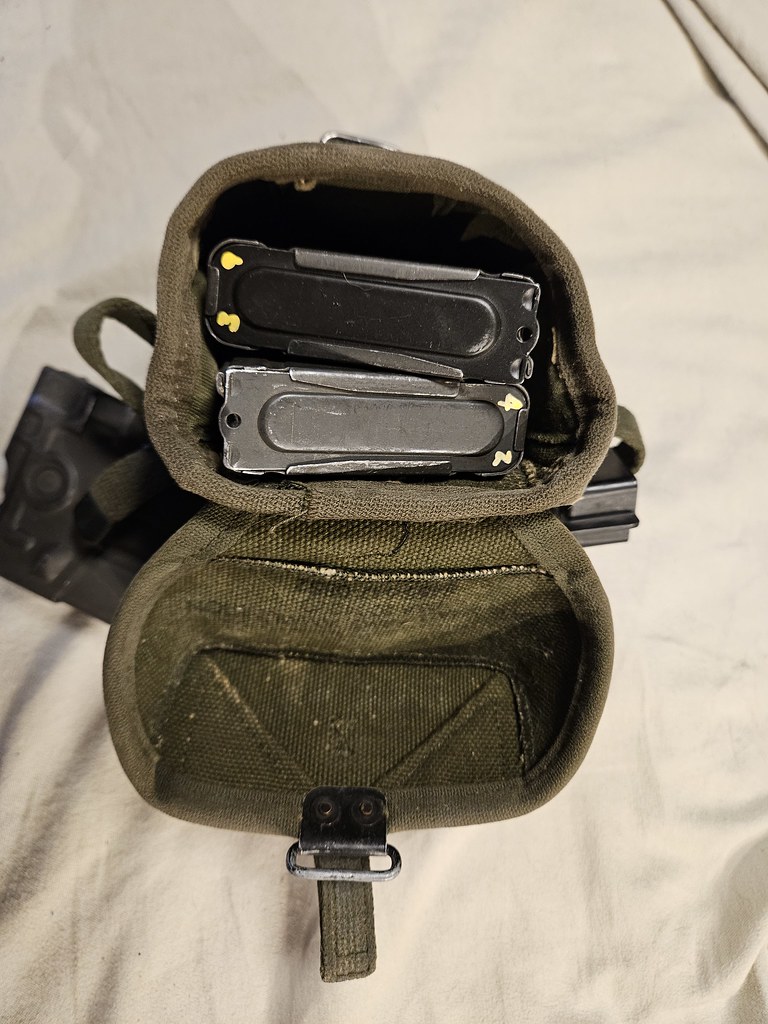
The “universal” in the designation indicated that it held 2x M14 rifle 20-rd magazines, 4x M16 rifle 20-rd magazines, 4x M2 carbine 30-rd magazines, a bandoleer of 6x 8-rd M1 rifle clips, 8x M1 clips without bandoleer, 2x BAR or Australian L1A1 rifle 20-rd magazines (tight fit), 24x 12-gauge shotgun shells, 3x 40mm grenades (two nose down, one horizontally on top), or 3x hand grenades internally. M16 magazines were too short to conveniently withdraw, so soldiers inserted a field dressing or folded sock underneath to raise them. Some pouches were too tight and held only three magazines.
M16 20-rounders are irritating if you forget or forgo a sock or dressing in the bottom of the pouch, and are real pain if you stuff the requisite 4 magazines in there. Don't forget to stagger them so there's something to grab! Two of my pouches fit them easily, one is very tight.
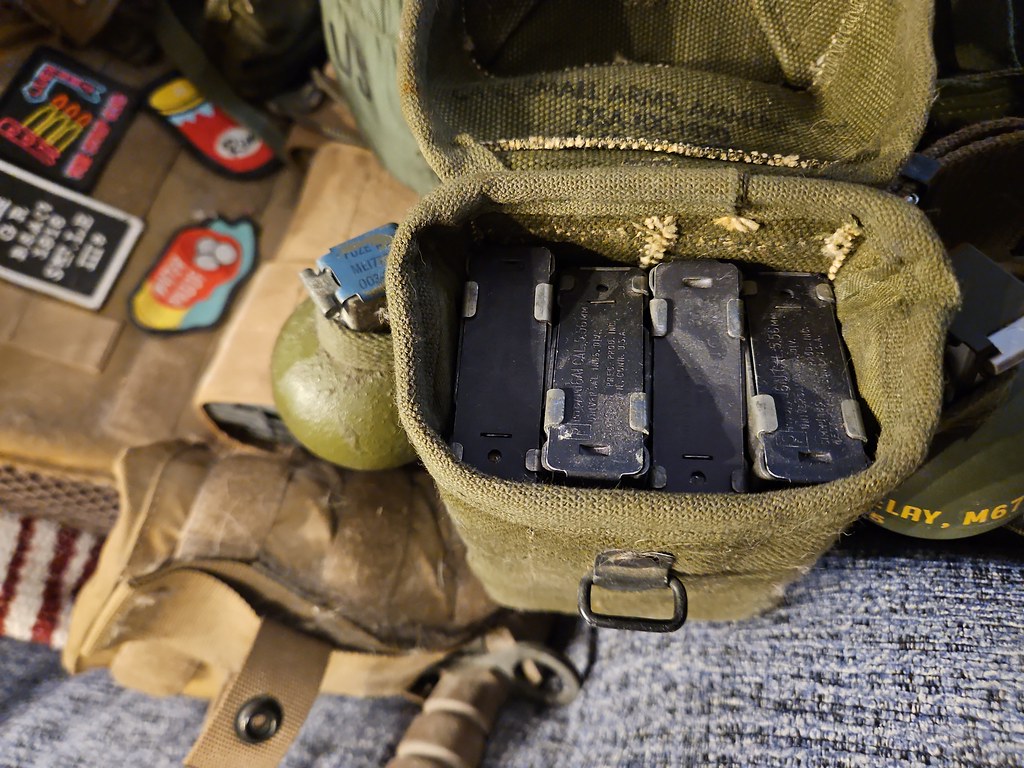
The carbine clips magazines were easy.
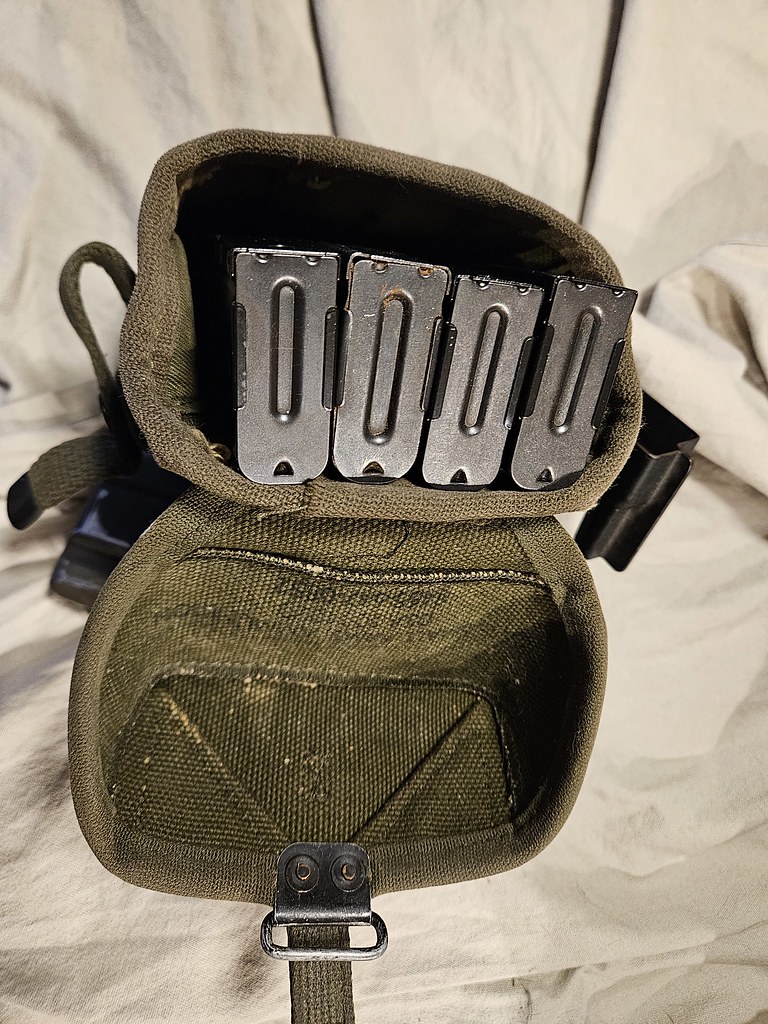
In most of these alternate uses of the universal small arms ammunition pouch, access is kind of an issue.
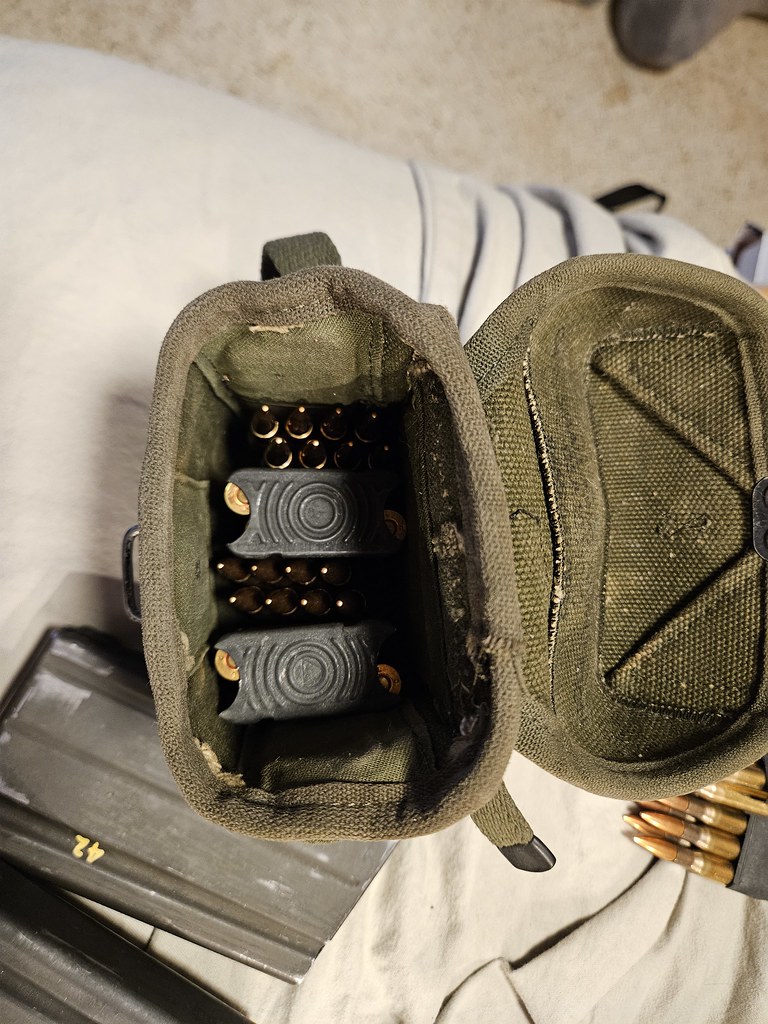
For the Garand clips, the four clips in the bottom are kinda fiddly to reach.
Twenty four 12-gauge shotgun shells.


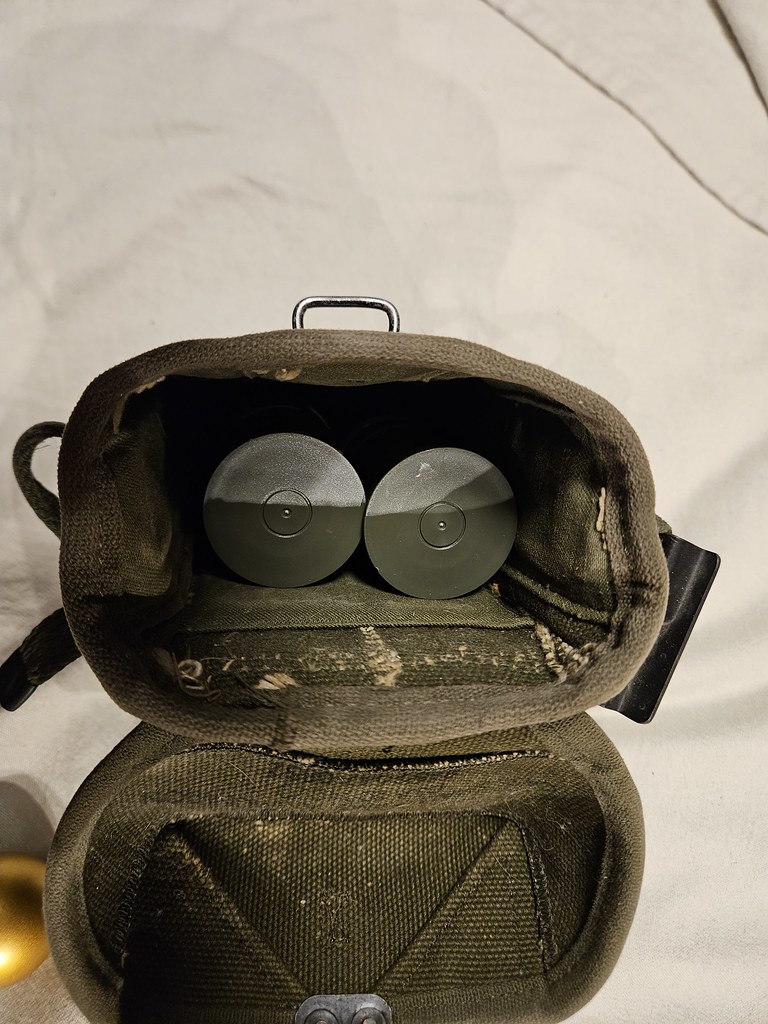
Three 40x46mm grenades


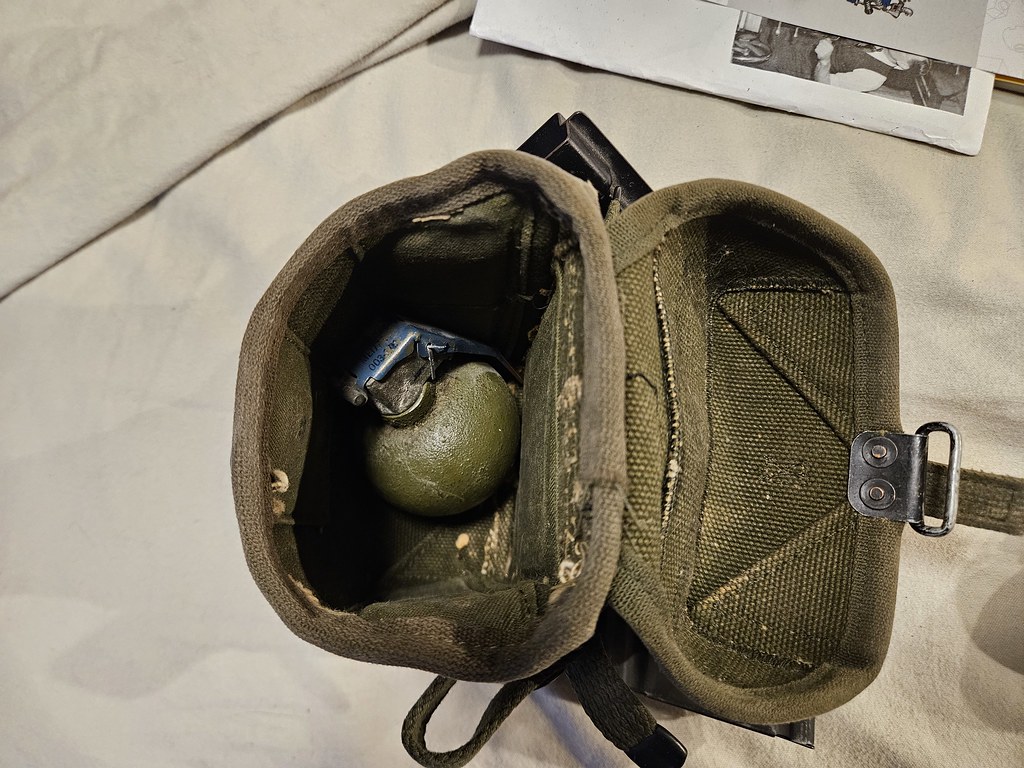
Three hand-grenades.

One!
Two!

Three! BWAH HA HA HA HA


I know that M14 (not shown) fit, metric FAL and G3 magazines also fit no problem two at a time.
 |
| 2x Metric FAL |
 |
| 2x Steel G3 |
You can even stuff 3 in if your try.

Not tested, so far, are BAR magazines. Accepting donations...
I said it during the defund the police campaigns.
I'm saying it again with the local politicians talking about the potential effects of Florida's proposed Amendment 3.
If the cops aren't coming, then the cops aren't coming.
That means that the normal people are free to act against criminals in a way unremembered since we delegated our police power to the people doing it for a living.
Criminals, you REALLY want the cops to come because the average person has no way to jail you and no motivation at all to hold a trial after catching you red handed.
Essentially it's a judge, jury and (literal) executioner situation without worries of the cops second guessing the decision.
Bring it, you tax fattened hyenas.
The satire site that fooled me was able to do so because they are hewing close to the truth with regards to the attitudes and expressions of the local politicians they are satirizing.
They've another one about how the people of St Pete are demanding high-rise apartments on the water, green spaces, elimination of car access, blah blah blah with an interview of a "local person" who says they just want to be able to afford their rent.
This is because St Pete has been tone deaf over the issues of housing and traffic.
The best satire always has a kernel of truth to it!
Anyone got two M14 and two BAR magazines they'd like to loan me so that I can take some pictures of them in an M1956 ammo pouch?
Except for 40mm grenades that's all I'm lacking; and air-soft dummy versions of those are on the way from Amazon.
Further referencing this post:
Yes, you can fit 4x 30-round M1 carbine magazines into an M1956 Universal Ammunition Small Arms Pouch.

UPDATE: THIS WAS A SATIRE POST AND I FELL FOR IT HOOK, LINE AND SINKER.
Found this on Facebook:
What is it they keep telling us? If we have nothing to hide, we have nothing to worry about?
ST. PETERSBURG — A leak involving the city's automated license plate reader network has allegedly exposed an extramarital affair between two high-ranking St. Pete officials after records documenting months of late-night travel were obtained by TMZ.According to the leaked data, one official's vehicle made at least 17 late-night visits to the home of the other, frequently arriving after 11 p.m. and departing before sunrise.Neither official has been publicly identified yet.City officials responded to the apparent breach by ordering an emergency review of the Flock system and the privacy risks associated with storing vehicle-location data.The review reportedly concluded that additional protections are needed for elected officials, senior administrators and other designated personnel. Under the proposed safeguards, registered vehicles belonging to qualifying officials would be automatically excluded from the system, with detections neither logged nor stored."No public servant should have to wonder whether their movements are being recorded, stored or potentially accessed by people they don't know," a city spokesperson said. "Elected leaders deserve a reasonable expectation of privacy as they go about their daily lives."Officials stressed that the proposal would not affect the collection of data belonging to ordinary residents.Local development advocate Graham Whitmore praised the distinction."There's an enormous difference between tracking ordinary citizens and tracking the people responsible for tracking ordinary citizens," Whitmore explained. "One is an important public-safety tool. The other is an alarming invasion of privacy."Whitmore also rejected criticism that the policy would create a two-tiered privacy system, noting that officials are exploring a program that would allow residents to apply for similar protections starting at $420 per month, following a $69 application fee and background check."Nobody is being denied privacy," Whitmore said. "We're simply asking people who value it to help pay for it."Officials declined to identify the individuals involved in the alleged affair, citing their ongoing commitment to personal privacy.
$420 a month to get the tier one privacy?
I have one. Every single public official's address, all their phone numbers, all their email addresses and all their license plates published in a searchable database.
Why them?
Because they, literally, fight tooth and nail to get and keep the jobs they are elected for.
You wanna be in public and wield that kind of power?
Fuck your privacy.
Don't like being exposed like the unwashed?
I'm sure you have a degree to fall back on, or some work experience you can put on your resume, and get a job in the PRIVATE sector.
You suck on the Gubmint Tit, you let us know where you are at all times.
Fuck all y'all.
PS: Please enjoy the budget haircut coming with Amendment 3 you tax fattened hyenas!
I watched a video about how bad primary sources are and remembered about how bad eye-witnesses can be...
And I'm sitting here seeing it from the inside.
I have conflicting memories of the Berlin Wall falling and where I was and what I was doing.
Records show that I was being treated for breaking my legs after a fall from the turret into a ditch.
But I remember seeing some AFN footage in the company day room.
Which makes me think command dithered a while before sending us to the battalion maneuver area in the tanks to sit and do nothing until I broke my legs.
Heck, I can't even remember for sure if we'd finished transitioning from the M1(IP) to the M1A1(HA). I'm pretty sure we had. I'm pretty sure we'd even gone to one gunnery with the new tanks.
But I don't know like I did before.
It'd help a great deal if there was any admission on the internet that 3-34 Armor was at Panzer Kaserne in Böblingen from 88-90 with the 1st Infantry Division (fwd).

We're on this chart anyway!
I think my memory is correct about the transition because I also found this:
1st Infantry Division (Forward), Göppingen (Germany)
But I needed outside information to confirm my memories.
But my incorrect memories would be quoted as a primary source by a historian...
So many of the stats of published guns in GURPS don't match what Gun Stats generates that I am tempted to do the slog and make Gun Stats compatible versions of all of them.
Especially in light of finding that shotgun pellets do more damage when calculated by themselves as opposed to calculating a group in a shotshell.
What else do I have to do?
In the quote in this post it says that you can stuff 8x 8-round Garand clips into an M1956 universal ammunition small arms pouch.
Confirmed!


ወዳጆች፣ በእርግጥም ዛሬ "እንደ ባህር ላይ ዘራፊ (ፓይሬት) የመናገር ቀን" ነው!
ነገር ግን፣ እውነተኛዎቹ የባህር ላይ ዘራፊዎች "እንደ ባህር ላይ ዘራፊ የመናገር ቀን" በሚያዘው መልኩ አይናገሩም ነበር።
ያ አነጋገር፣ ለዲዝኒው "Treasure Island" (የሀብት ደሴት) ፊልም ባደረገው ትወና ላይ ልዩ ድምቀት ለመፍጠር የወሰነው ተዋናይ ሮበርት ኒውተን የፈጠረው ነበር።
ይሁን እንጂ፣ የኢትዮጵያ ባህር ላይ ዘራፊዎች የሚናገሩት በዚህ መልኩ ነው!
Harvey's preferred AR is Kevina.

She's had zero problems shooting it.

Which is why Cheyenne biting her was a surprise!
Remember when I mentioned that the M1956 pouch was not produced in large numbers?

The wide world of reproduction has got you covered!
Prolly more repops made than the real thing.
Harvey took Cheyenne, the Platoon carbine, to the range to prove that she could!

We paid extra attention to getting the stock in her shoulder pocket and making sure she had it pulled hard into her.
 |
| 25 yards with irons. |
She says it still hurts, but not a horrid stabbing pain; more like someone yelling, "slug-bug!" then wailing one on you.
So I had her try Dottie!
That went a lot better!
 |
| 25 yards with Vortex Spitfire AR |
Dottie is heavier (8.8 lb.) than Cheyenne (6.8 lb.) and has an A1 stock vs a metal carbine stock. More mass over more surface area means less "impact" on the shoulder.
I did some shooting with Dottie too, but at 100 yards.

I, uh, well...
I'm out of practice. Still this is a much smaller group than my last outing. 4" at widest if you ignore that flier over his left shoulder.
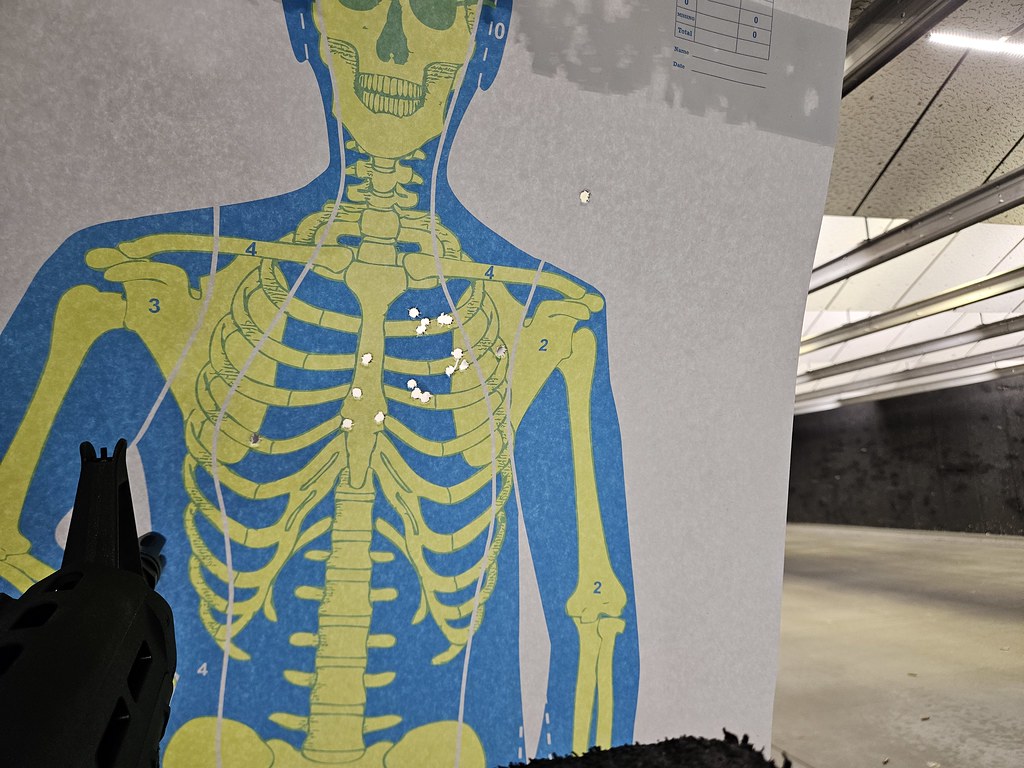
I knew I was getting that flier when I pulled the trigger too.
Still, Mr Bones is having a bad day. So is zombie Todd, come to think on it.
We've decided that Magpul makes a much better stock than Colt did in 1969 and that while she loves the Retro gun she's made, she's fine admiring how it looks rather than shooting it.
I don't take my Retro guns out much either, come to think on it.
"We easily gained access to the device because it lacked viable encryption. We have corrected that oversight!"
I was reading about how someone stole a Flock camera and managed to download much of the data onboard.
They mentioned a lot of the data was still encrypted and they couldn't access it.
But what I wondered about is if someone could steal the camera and change things so it reported healthy and happy to the mothership, but was actually not doing a gorram thing.
Then I wondered if this same someone could encrypt what they'd done so fully so as to force Flock to buy new hardware to fix it.
"Pitting together charismatic stars in an underpowered caper, Guy Ritchie's In the Grey is a slick action vehicle whose lack of fresh ideas ultimately put its entertainment value in the red."
-- Consensus at Rotten Tomatoes.
Rotten Tomatoes says 52% for critics and 82% for people.
I generally like Guy Ritchie as a director and enjoy his films.
This was no exception.
The plot is laughably thin. They telegraph what's going to happen so even the most dense viewer will see it coming.
I have seen this movie before. Dozens of times.
I don't care. I liked this movie when they did it in the 1980's. I liked this movie when they did it in the 1990's. I liked this movie when they did it in the 2000's. I liked this movie when they did it in the 2010's.
The picture Marv was calling, "camera camera camera!" for:

Honestly, we don't see a gator every day.
One of our friends who lives near where this was taking says its name is Henry.
By-The-Basic-Book and High Tech, a 2-3/4" 12ga 00 Buck round flings 9 round lead balls doing 1d+1 pi each out to 40/800.
Looking up a typical loading I get 9 lead balls at 1,325 feet per second and Gun Stats calculating a "shotshell" gets 1d pi each out to 40/800.
So far so good, just a little less damage.
Fire a single .33 caliber ball at 1,325 fps from a smoothbore and you get 2d pi out to 60/700.
Oops.
The calculation for the single ball is closer to what the magazines writing about shotguns says about performance because they equated .36 cap and ball pistols to 000 Buck.
In response to the clip going around with the African lady saying 'WHAT WHITE CULTURE!?!'
— The McMullan (@TheMcMullan) September 15, 2026
Because I can explain it in more detail than anyone else... here are the main things that create western civilisation.
The principle, the law of nature that is an adaptation to and what…
Read the whole thing.
Facebook constantly suggests products I might want or need.
A repeat offender is 4Patriots.
They have a big battery with a solar panel they're selling.
"That'd be handy for hurricane season," I think.
Do you know how much one costs?
It's not on the main page for the item.
They tell me why such a thing would be handy. How much it can power and for how long. How fast the solar panels can recharge it.
But no price.
To approach the price I have to "Start My Order".
Now I know that it's $1,500.
But I would have preferred not to click the order link to see the price.
You might notice that the blog-roll sidebar on the right is not updating with the latest post from their respective authors.
This is a Blogger-wide problem.
When I replaced the battery on The Beast, I turned on "engineering mode" which has a readout for the battery voltage and charge percentage.
For three short trips the, brand new, AGM battery showed 69.8% charge and 15.0 to 15.2 volts.
That's a little alarming, but the G8 forums say it's not out of the realm of possibility.
Today, on the way to the VA, the voltage was a far more sane 14.0 to 14.5 volts and the charge percentage crept up from 70.4% to 92.4% by the time I got home.
On the trip to one of the local breweries, voltage was down to a comfortable 13.6 to 13.9 and was reading 96.4% when I pulled into the garage.
I am thinking I'm good.
What's interesting is the best that percentage ever showed with the old batt was 74% and that's damn close to the difference between the 660 cca Group 48 and the 880 cca Group 94R.
Looking back, I realize that I've been doing this for a while.
Even stranger is some of the people I fogged over, I had thought had bailed on me when it was me walking away from them.
I have long maintained that I'm not a very enthusiastic Republican.
The problem I have is that I am emphatically not a Democrat on so many issues.
Put another way, I have more in common with R than D.
That leads to holding my nose and voting the lesser evil and knowing that I am still getting evil at a slower pace.
The Republicans take this as a shining endorsement of the things I most disagree with them about, and I complain about that.
Democrats take it the same way.
They think my opposition to their candidate as wholehearted support of the Republican I helped elect. Like their candidate had nothing to do with it...
So I end up giving the Devil a favorable mention because Hitler invaded Hell.
This was especially so when W was president.
My liberal friends kept missing that Slick Willie only pissed me off on about three things. His swing to the center didn't offend me at all.
I do notice that if there's an (R) behind a candidate's name then things they do that someone with a (D) behind their name did, it's unconscionable.
All the example you need for this is all the anti-immigration statements that Democrats issued for decades.
Well, Mr Punch said he wanted me to look up words...
Today's word is "Gypsy," which the Roma people complain is an exonym for them.
And it is.
But it originates as slang for Egyptian.
It spreads as both a term describing anyone of a swarthy complexion and to people who are thieving by nature.
The thief part comes from it being ever so stylish to have Egyptian servants and associating servant with minor thievery from the estate.
Roma are dark skinned compared to most of Europe, so one can see where it jumped to them.
Roma have a reputation for being less than honest with outsiders and generally not respecting property rights of the people they live amongst.
But did that come before or after they became associated with the household staff stealing the silverware?
Remember, it's not slander if it's true.
So far the elimination of the word gypsy from the Basic Set has been justified on the grounds that the Roma don't like to be called that, not that the accusations don't have merit.
I find that telling.
But also, IF it is true. If it is not, then I'd be offended at being accused as well.
Western Civ DOES have a bad habit of falsely applying bad attributes to outsiders and has done it so often we're in a boy-who-cried-wolf situation when we find someone who actually HAS those bad attributes.
I think, though, that the way to deal with an exonym is to embrace it, not reject it. Kill its power to offend. I'm 1/2 Dago WOP. My grandfather on Mom's side experienced all that prejudice and bigotry, but here we are, not being offended by it because we decided that it had no power to hurt us.
Sticks and stones; you choose to be a victim of a slur or not.
For a recent example, look how conservatives embraced "deplorable."
Chink is a word to describe a gap in armor protection that dates back, at least, to the early 16th century.
It is also a word to describe a sharp, clear metallic sound, dating from the late 16th century.
It is ALSO a racial slur dating from the very beginning of the 20th century.
Which means you need some context when you say, "I'm targeting chinks in armor."
Is it an innocuous attempt at aiming for a gap in the protection, or a racist way of saying you're attacking the Chinese troops?
I remember this being an issue on a few fora.
Thankfully, the older word remains. Even in GURPS 4eR.
A long while ago I stated remembering that the Army kept us, arms and ammunition well separated unless we were actually on the range and going shooting.
I misremembered something.
The ammo racks of the tanks were loaded with war-shot ammo unless we were going to the range for gunnery. I also recall, now, removing all that ammo from the tank before going to Graf and experiencing my first round of being responsible in the paperwork for anything at all thanks to my minty new stripes on one of those trips.
Literally nothing but discipline keeping us from loading up an APFSDSDU round and picking a target.
Come to think on it, literally nothing but self control keeping us from firing up a tank and rolling out the gate with it too.
The Army did make us dismount all three machine guns and keep them in the arms room. Ammo for the MG's was kept in the bunkers a longish ways away.
Same same for our pistols and the tank's M16.
Florida is experiencing a bad drought.
It's either the worst in 15 years or the worst ever. Sources are stepping on each other.
I was trying to find a picture of a pet and ended up finding a picture of my, mostly dead, grass in my back yard from 2004.
I did a bit of Googling and found Florida was experiencing a drought in 2004.
My lawn looks better now than it did then, so my particular patch of grass is not seeing a worse drought than 22 years ago. It is clear, though, that we are still in drought conditions.
Five years ago my grass was LUSH!
That photo also proves that all we need is some rain and the grass will get lush again.
Until the next drought.
Tell me what you're going to say.
Say it.
Tell me what you just said.
That's normal, everyday, stuff we've seemed to have lost.
Yes, this is do as I say, not as I do because I'm not placing myself as someone who's trying to keep my readers informed.
But over and over the people who are trying to place themselves as information sources keep forgetting to tell me why they're explaining something for such a long time that I can't tell what their point is.
And if YouTube inserts an ad into your explanation before you reach that point, I'm stabbing the back button.
Let us also be honest.
The reason you're rambling like you are is to make the video long enough that the algorithm moves it up past the point where you get paid for putting it up there.
But cramming a few seconds of content into several minutes of video just means most of the video could be skipped and after a few of them, I know that's how you work and I will seek other sources for information on the topic.
Clues that your youtuber will waste your time:
Recites their resume and lists their awards at the beginning of every video.
Explains why you'd be watching a how-to video about how-to repair something.
Begins by answering a question not yet stated.
I was sitting here, being bummed, about friends that had left my life.
Abruptly from my perspective.
I realized that I am extremely happy they are gone because I remember the W. Bush years.
I don't think I'd have wanted to deal with them in the Trump era.
There's a thread on arfcom that's, no shit, debating which flip-up back-up-iron-sight is best.
Optics have gotten to the point that back-up irons are nugatory.
And I say that as a GM who really WANTS to fuck over a player counting on that optic!
We're to the point where the best BUIS is the one that weighs the least and takes up the least space.
All the rear sights put the same little hole in the same place it would be if the AR had a carry handle.
The front sights literally use an M16A2 front sight post and put it where it'd be if there was a normal front sight base.
Nugatory!
A case can be made for skipping them altogether.
I can't, quite, bring myself to skip having irons on a "fighting" rifle.
Lindsey Clancy is not a triple murderer.
She's a triple killer.
Murder is a legal term and she has not yet been convicted.
She has admitted, and so stipulated for the court, that she did kill her kids.
I remain hopeful she will get her comeuppances.
It wasn't a draw problem.
It was a dead battery.
New 94R/H7 (the correct battery) replaces the 48/H6 the previous owner had in it.
Can't bitch too loud, it ran for 4.5 years with me and about 2 with the previous owner.
Nine years ago we were digging out from Hurricane Irma.
This year we haven't even gotten much rain.
Dear Restaurant Chains;
I want to see what food you have on the menu without entering into the ordering section.
Especially since you lock the ordering section when you are closed most of the time.
Is it really so hard?
Local places manage to have their menus online, separate from the ordering system.
Thanks!
Even though it's been 25 years since 9/11 I am not done being angry about it.
I still feel that since it was done in the name of Islam that Islam should have done a lot more to show it didn't represent their feelings.
To the point that the next time someone does something in the name of Islam we just make Mecca the new land of the midnight sun with a Beatles soundtrack.
Then carpet bomb anyone who gets upset about it.
Because I am done.
I have noticed, however that much of the middle east has been a lot more taciturn about "Death to America" of late.
Even heard rumors that the current management of Saudi is a lot more moderate than their grandparents and there's a good chance that the Wahhabism wing will get a lot smaller.
One can hope.
To any and all Muslims in the US: Tomorrow is not your day, so lay the fuck low; we're still licking our wounds and you aren't going to talk us down next time.
Because I have been paying the same mortgage for 24 years, I am, apparently, "bad with money."
To be good with money I was supposed to refinance every time I could and chase an ever lower interest rate.
I do know that because I was ACTUALLY very bad with my money 24 years ago that I couldn't have gotten a better rate than the 7.375% I've been paying until just about a year ago.
I prolly ain't really great with my money, but I'm not over extended.
We're paying what we owe to whom we owe as agreed.
We're not sweating maximizing at the margins.
Of course, we regard our house as a box we keep ourselves in rather than an investment vehicle, which is also "bad with your money."
On the whole, I'd rather be happy.
Fighting the battle of the bulge and eatin' keto breads now.
Nature's Own actually tastes and feels like bread!
Harvey has been buying it for a while because of her diabetes, I've only recently started eating it too.
President Trump has offered the American people a bribe to vote for Republicans for Congress.
They take both houses, he vows to give all of us $5,000.
Yippie?
That's like $1.2 trillion bucks.
No way this massive cash distribution will, in any way, be inflationary...
Printer go brrrrrrrrrr, I guess because I'm pretty sure the gubmint ain't got no extra $1.2 trillion laying around while they deficit spend normally.
I generally like Trump, but shit like this ticks me off.
I'd much rather he vowed to get the government to spend $5,000 less for every adult.
That'd be some positive change that'd be a real benefit to everyone.
Digging into the, what seems to be excessive, draw of The Beast's electrical system.
It appears to have been a decision on the part of Holden or GM engineers that the body control module never quite goes to sleep.
It stays more awake than the Australian version of the car to make sure that essential police equipment gets a trickle of power and to decide how much.
This amounts to about 0.4 amps. Which is a lot for a car that's shut off.
The "problem" area is the extra fuse box under the driver's kick-panel. This is where the fuses for all the Americanizations live.
But, the GM engineers reason, cop cars are constantly in use, the extra draw just won't come up!
And knowing about the draw being normal means I need to start the damn thing at least once a week when the battery is connected or keep a charger on it.
PS: Don't feel too smug about your own car shutting further down than mine, OnStar is calling home every few hours and transmitting. The dear, departed, Precious would drain the battery sitting idle too.
Our lawn mower died. Rather, it will not start.
It doesn't seem to have compression.
It's about... um... 11 years old.
I think that's a good run.
I've been wrenching on it for the past five to avoid replacing it.
We replaced it with a Ryobi 40v 20" mower. Battery powered.
I kinda feel dirty, but it was still $100 cheaper than the equivalent gas model.
Something I can do with the battery powered model that I can't with a gas one is store it folded up and standing on its end. No gas to leak out while vertical.
I was surprise at how normal it sounds. Most of what I think of as lawnmower noise is apparently the blade spinning.
Did you know that if you don't start a 2012 Chevrolet Caprice PPV (6.0 L V-8) for three weeks, the sleeping electronics will drain the battery dead?
I know that now.
Luckily, I have an excellent battery charger.
All better now.
The car draws between 0.3 and 0.5 amps when it's sitting there waiting for you to come back.
It's the keyless entry system waiting for your signal, I am told.
And keeping a couple volatile memories alive for the clock and mileage calculator.
The Matrix is a system, Neo. That system is our enemy. But when you're inside, you look around, what do you see? Businessmen, teachers, lawyers, carpenters. The very minds of the people we are trying to save. But until we do, these people are still a part of that system and that makes them our enemy. You have to understand, most of these people are not ready to be unplugged. And many of them are so inured, so hopelessly dependent on the system, that they will fight to protect it.
--Morpheus The Matrix
GURPS: Basic Set 4th Edition Revised p. 518-519 says:
Loyalty
We offer no "loyalty table" for enslaved individuals; the GM must use common sense. The orcs' victims will escape or revolt at any opportunity, except for those too will-broken to make a move. The Janissary will shout, "Traitor!" and try to arrest anyone who attempts to "free" him.
GURPS: Basic Set 4th Edition, Vol. 2, Campaigns p. 518-519 says:
Loyalty of Slaves
Determine a slave’s loyalty per Loyalty of Hirelings (above). However, slaves are less predictable than hirelings. After determining the slave’s initial loyalty, roll 2d on the following table to determine a loyalty modifier:
- 2-7 – No modifier.
- 8 – He was enslaved for some crime, and resents it: -1 to loyalty.
- 9 – As above, but -2 to loyalty.
- 10 – His previous master was very cruel. If he is treated with kindness during the first week, apply +2 to loyalty; otherwise, no change.
- 11 – He has a fanatic hatred of slavery. If treated well, he may like his masters as people, but will still escape as soon as possible. If treated badly (or even “average” for a slave), his loyalty drops to 6.
- 12 – He has the Slave Mentality disadvantage (p. 154), and considers himself truly the property of his owner. His loyalty is automatically 20. You need never check loyalty; he will not demur, even if given orders that condemn him to death.
Make loyalty checks for slaves as for any other hirelings. Modify loyalty by +1 or +2 if they are in a situation where they have nowhere to run!
And I wonder why this change was made. Their whole point about the changes they make to slavery is about how it's dehumanizing and the players should be the heroes who oppose the very idea of it, but this is a table of very human responses to being enslaved in most places.
Making me work it out on my own as the GM does work, and I've been doing it that way since forever because I never looked for this table.
Still, how does this table convince someone that slavery is OK?
The old version says:
Legal Complications
When slave-holding PCs enter an area where slavery is illegal, they must either dispose of their slaves or pass them off as free servants.
Possible anti-slavery attitudes include: legal to own slaves, but not to buy or sell them locally; legal for non-citizens to own slaves while passing through, but illegal for permanent residents to own them; or illegal to own slaves at all.
A creative GM may impose other laws and customs regarding slavery. For instance, it might be legal to enslave members of some social groups or races, but not others. There might be ways for a slave to earn his freedom – some societies might even permit slaves to own property and buy their freedom.
Eliminating the players owning slaves meshes with the idea of them as the heroes, but the rest is decent, generic, campaign guidance.
The new version is much shorter.
Social Complications
No one from an even vaguely egalitarian society likes those who enslave others or profit from it; they will react at -1 or worse. Enslavers are usually overtly Callous (p. 125).
Where the practice is illegal, they have Social Stigma (Criminal Record) (p. 155), and are treated as if they had Sadism (p. 152) – even if they don’t. Exception: The masters of zombies, golems, IQ 3 tentacle beasts, and similar “pets” instead suffer the usual reaction penalties of necromancers or keepers of horrors, and may even inherit the creatures’ penalties!
I like this verbiage. Adding it to the original would have been better, I think, than dodging the idea that slaves can be broken to the point that they have come to completely accept their lot even if they aren't happy about it.
They say it's just a drill, but I've noticed a couple articles about the normal British citizenry being more effective about the incoming tide of immigrants.
I can't help but wonder if this is really a precursor to quelling an incipient rebellion.
But if it is a rebellion starting, I hope they feel free to use the words from our declaration of independence to list their grievances.
Something that comes up in discussions in fantasy worlds is if creatures like centaurs have the same dietary needs as horses, or if they get by on a normal human's diet.
Remembering that I live in the future, I googled how many calories a day do people and horses need.
A human female needs between 1,600 and 2,400 calories.
A human male needs between 2,000 and 3,000.
A horse needs 15,000 just to stand in it's stall and 25,000 to 33,000 if you put them to work.
Aside: Adventurers NEVER bring fodder for their horses. 25,000 calories of, dry, oats is 142 pounds of oats. 50 lb. of alfalfa also works.
Since the head on a centaur is a human head and that means human jaws and teeth, they're probably eating people-food.
25,000 calories of steak is 34.24 lb.! Almost 21 lb. of ground pork. It's almost 14 lb. of cheese. 324.2 lb. of lettuce. 240.4 lb. of carrots.
If centaurs only need a normal human diet and quantities, clearly something magical is going on with their metabolism.
If they need horse calories per day, there's a -20 point disadvantage Increased Consumption - 2 that fits the bill.
The Centaur template from Fantasy p.105 does not list this disadvantage, nor any limitations on going into low to no mana zones. The same for the template on p. 188 of Banestorm.
Odd, huh?
I was surprised that I owned two of the guns mentioned.
A Savage 99.

A Winchester Model 54.

My 54 is in the wrong caliber, it's in .30-06.
Both guns still shoot just fine.
They exceed both my eyes and my skills.
Saw a compilation of military fails.
One of them was a group of Marines looking in a grassy field for a missing suppressor.
I remember during Reforger hearing about a unit that had lost an M9 near where we were operating.
We all looked at each other in the turret for a moment and simultaneously said, "free pistol!"
Hey, it's not like we signed for it!
Sadly, we did not find it.
Starting Tuesday, it is gauche to wear white until next spring.
#TheMoreYouKnow
hat-tip Mr Fleetwood
Doing the Gun Stats math on 12ga 2-3/4" shotgun ammo.
It doesn't quite match the Basic Set or High Tech stats.
One load of 00 buck matches exactly, most don't. The 1,325 fps stuff gets 1d pi instead of 1d+1 pi. 1,600 fps gets it to 1d+1 pi, but that's a single Hornady loading.
But once you do #2 birdshot, the damage stays 1d-5(0.5) pi-, you just get more pellets and a higher chance to hit, until #9 birdshot when it changes to 1d-5(0.2) pi-.
I will probably calculate all of the shot sizes because you lose range with every decrease in shot size.
00 Buck is 40/800 for range. #4 birdshot is 16/312.
Steel shot doesn't do less damage than lead, or lose range, but you get more pellets.
NRA is suing over Denver's non-resident carry ban.
Back in 2007 when I was in Denver to say goodbye to Mom, my Florida permit was good to go.
Not sure what happened in the meantime, but...
The NRA wouldn't have to sue if it hadn't changed.
My favorite local brewery does a customer appreciation day over Labor Day weekend every year.
They grill burgers and hot dogs and give them out for free.
Something that stands out is how many new faces I see there.
The customers bring their extended families for free grub...
But they're not the worst. You can make the case that they appreciate the family letting their customer come to the brewery.
The worst are the people, families in tow, who have never patronized the place.
It ticks me off.
I like the owners of the brewery and I don't like seeing these people take advantage of them.
If someone is so mentally off center that they're a danger to others, they need to be kept from others.
Not guilty by reason of insanity should lead to a mental hospital.
The stay to be governed by how long it takes them to regain sanity and if they never do, then they stay forever.
An insanity plea shouldn't be a means to escape all the consequences of their actions.
Arguably, a successful insanity defense should yield a worse "punishment" than prison because release is predicated on showing they have, fully, recovered from their psychosis and are safe to be among the rest of us. That predication makes the sentence open ended and indefinite.
I'm open to the argument that any mental illness that leads to a homicide should end in euthanasia. I can also see how dangerous that idea is, so I'm not advocating for it.
We've a mental health problem in the US. We dismantled a working system in the Reagan era, rightfully in too many cases, and did nothing to replace it.
Solid, compassionate, institutions caring for the mentally ill were closed with the callous and abusive. Thanks Sixty Minutes!
It does need fixed, but who do you trust to do it?
It only took 18 minutes for a jury to convict John Battaglia for murdering his two daughters.
His defense (on appeal) was remarkably, and superficially, similar to Lindsey Clancy's.
The Lovely Harvey is following this trial closely and I'm getting snippets.
Something that stands out is the willingness to create a narrative where her husband is actually responsible, even if she did the actual killing.
But none dare call it sexism.
Florida, where guns are so easy to get that criminals are forced to use pick-axes to assault people!
But since guns are easy to get, our assailant got shot for his trouble.
Slow clap.
Note that this was the second time the assailant had come at the victim.
The pace of armor development and rounds that penetrate said armor is evidenced by the staggering number of new rounds since the Cold War ended.
The Russians improve reactive armor, we improve the APFSDSDU.
We improve the round, the Russians make another improvement to their reactive armor.
Lather.
Rinse.
Repeat.
But such things are, presently, not in the damn rules for GURPS.
So I'm making shit up. SWAG, but still...
1st generation Explosive Reactive Armor (Blazer 1982, Kontakt-1 1985) eliminates the armor divisor of HEAT and HEDP and nullifies the special effects of HESH; making them just HE rounds.
2nd generation Explosive Reactive Armor (Kontakt-3 never produced), as 1st gen plus: Reduce the armor divisor of AP type rounds from (2) to (1.5).
3rd generation Explosive Reactive Armor (Kontakt-5 1988), as 1st gen plus: Reduce the armor divisor of AP type rounds from (2) to (1.25). Reduce the armor divisor of the second charge of an MS-HEAT round from (10) to (5).
4th generation Explosive Reactive Armor (Nihz 2003), as 3rd gen, except change the AP armor divisor from (2) to (1).
Spaced armor, as per High Tech p.229, is designated with an S after the DR gives 1.5x the DR vs HEAT and HEDP rounds and negates the special effects of HESH.
Laminated armor is designated with an L after the DR and gives 2x the DR vs HEAT and HEDP rounds and negates the special effects of HESH.
Starting with the M829A2 APFSDSDU round ignores the effects of 3rd plus generation ERA. Not sure what to call this ammunition upgrade. ERA Proofed? Reinforced Rod?
Deserter's conviction reinstated!
I can't believe this shit is still going on, nice to see resolution happening.
Gun Stats assumes that both shaped charges are the same size!
So you calculate them from the published penetration in millimeters, which comes out as half as much as a single stage, then double that damage.
A normal HEAT round that punches 900mm will do 6dx12(10) cr ex linked 6dx5 cr ex.
An MS-HEAT round that punches 900mm calculates at 6dx6(10) cr ex linked 6dx5 cr ex.
If the target is protected by explosive, reactive armor MS-HEAT does the listed damage as if the ERA wasn't there. If it not protected by ERA, then double the listed damage.
Silly me, I've been finding out the penetration of the precursor charge and main charge then adding them.
For example, the PG-29V fired from the RPG-29 will penetrate 900mm RHA, but only 750mm it it's protected by reactive armor.
So that means the precursor charge penetrates 150mm on its own.
I've been showing this as 6dx2(10) cr ex follow-up 6dx10(10) cr ex linked 6dx5 cr ex.
It comes out the same on RHA, but penetrates better when there's ERA than the rules as written.
Some write ups comparing the fire control of the M60A3 and M1 make it seem like there's no reason to use the M1 fire control system.
Both are fully stabilized.
Both use laser range finders.
Both have wind sensors.
Fruit, fruit. Tits, tits.
The M1 computer has more processing power and does the job faster, but it doesn't make a big difference when the time choke-point is the loader.
The gun is slaved to the sight.
What this means is when I'm tracking a target and stab the lase button, my view, and the crosshairs stay on the target and the turret shifts.
But what makes the M1 system better?
In a word, integration.
The M1, and it's fire control computer, were designed together.
The M60's system is an add-on that had to work with existing hardware and that makes it a bit clunky. This article gives a decent description.


We had a HEAT round battle carried and we were pieing the corner of an alleyway when we got hit. I thought they got a 1:1mil shot down our gun tube at first.I was the loader. My gunner and TC both got peppered pretty well from the blast and I caught a bit as well.Gunner got medevac’d to Germany because of the flash burns to his face. “Ruined his modeling career” as he put it.The hole in the sponson box was actually from an earlier rpg attack, but it hit sandbags in the box and never detonated.The small hole at the lower left side under the smoke grenade box is the entrance hole of the one that did us in.Plt Sgt had me digging in the hole with needle nose pliers trying to get something out when Col. Robert Abrams (our Brigade Commander at the time) walked up and said “what the fuck are you doing?!?” Good times.”
The write up explains it's an M1A2SEP.
That makes the side turret DR 1,580L. 1,147mm RHAE v HEAT.
For a heat round to penetrate that it needs to be, at least, 6dx15(10) cr ex, for the average hit to penetrate. 6dx9(10) cr ex can penetrate with a max-damage roll.
The PG-7VR warhead can penetrate 900mm of RHA with its tandem warhead. At first you think it cannot, but the damage roll is based on an average where all the dice roll 3.5.
I'm not showing all my work here, read the rules and it's clearer.
6dx4(10) cr ex follow-up 6dx8(10) cr ex linked 6dx5 cr ex; which is treated as a single 6dx12(10) cr ex attack if there is no reactive armor. On average it penetrates DR 1,260L
So, DR is doubled for laminated armor vs HEAT. 3160.
Divided by the armor divisor of 10. 316.
Divide by 12 to find out if we can penetrate with this round, if it's more than 36, no. 26.3333.
The PG-7VR, on a good roll, can penetrate the turret side of an M1A2SEPv1.
This GURPS.

Public opinion is against Flock and other similar camera systems.
To the point that the local sheriff canceled their contract with both Flock and Axios.
Governor DeSantis banned them from FDOT right of ways.
But the press is publishing lots of articles like the picture above.
It seems very much akin to saying that since the Nazis MUST have killed a few people who deserved it, then The Holocaust is completely justified.
Some of the nearby county's sheriffs are not getting the message the public is sending and are saying that they will continue using Flock cameras that are placed on private property. I think some of them have been running unopposed for so long they've forgotten they're elected officials and subject to the opinions of their constituents.
I've noticed that the Soviets had better guns and thicker armor than the NATO nations until relatively late.
NATO didn't start getting gun parity until the British 105mm L7.
NATO didn't start pulling ahead in armor until Chobham.
NATO tanks are almost always taller and heavier than their Soviet counterparts.
So, NATO was screwed before tanks like Abrams and Leopard II hit the scene?
Maybe not.
For the gun and armor to matter, you need to hit, and the Western designers put a lot of effort and thought into fire control.
The first step in accurate fire is an accurate determination of the target's range.
You'll see little bulges on the sides of US tank turrets. These hold the objective lenses of the range finder, either coincidence or stereoscopic.
The earliest of these give the range which is called out and the appropriate stadia in the optic is aligned with the target.
The US miniaturized the mechanical fire control computers it'd been using on ships and put them in tanks. The range obtained from the rangefinder could be input into the computer, along with wind speed and the reticle would be shifted so the gunner need only align a, relatively simple and uncluttered, crosshair on the target to hit.
This is all happening while the T-55 has no rangefinder at all and the T-62 uses stadiametric ranging.
The US then automated the process by putting a linkage between the rangefinder and fire control computer.
This was in the 90mm equipped M48A2, in 1953!
The M60A1 started with this. Later versions got a solid state computer, laser rangefinder and sensors to compensate for wind muzzle droop and cant.
This is all in addition to stabilization that allowed for firing accurately on the move.
Of course, to effectively use all this fun technology requires some education and training that's, typically, absent from the Warsaw Pact and Soviet customers.
Israel vs et al kind of proves the thesis.
If we're going to count all the variations of the M1816 musket as a single service weapon, then we really should count all the variations of the AR-15 as a single weapon.
The M16 series (including the M4 series) is the king of service life, 1966 to 2022 or 56 years.
56 and counting since the M7 roll-out has not been smooth by any measure and many units, INFANTRY battalions, not support units, are still rocking the M4A1.
If we count each variation as its own weapon the M1865 is still the shortest in service, but the average number of years we stick to a specific design drops precipitously.
Even within some very short lived designs, like the Krag, there's several sub-versions.
Sometimes it's hard to tell how long a weapon was the primary infantry arm because they didn't replace the old ones, just stopped issuing them in favor of the new one.
This is true of the M1816 series and the Krag. Units might have all the same gun, they might have a few of each.
Our first service rifle was, um, not a rifle.
It was the M1795, .69 caliber flintlock musket. (19 years)
It was replaced by the .69 caliber M1812 in 1814. (2 years)
It was replaced by the .69 caliber M1816 in 1816. They didn't have an "A" designation so instead of M1816A1, we get M1822, M1835, M1840 and M1842. The M1842 being the first caplock. The Army didn't really consider them different guns, just different designations to keep track of small changes. (39 years)
Those models were technically still front line weapons all the way to 1855 when we get the .58 caliber M1855 rifle musket in 1856. Followed by the M1861, and M1863. (9 years)
The first breech-loader is the M1865 chambered in .58-60-500 rimfire. This is also the first Erskine Allin trapdoor to be type classified! (1 year)
Then we get a trapdoor chambered in .50-70-450, the M1866. Then The M1868 and M1870. (7 years)
The cost of converting old caplocks turned out to be prohibitive and since they were making all new guns anyway, they decided on, yet, another chambering for the trapdoor. The .45-70 M1873. Then M1884, and M1888. (19 years)
Smokeless supplanted black powder and the .30-40 Krag-Jørgensen M1892 hits the scene plus M1896 and M1898. (11 years)
Then the M1903 Springfield in .30-03. Then the M1903 in .30-06 in 1906. (33 years)
The M1903 was, kind of, replaced by the "Enfield" M1917, but the M1917 was replaced by the M1903 after WW1. The M1917 doesn't really count because it was a secondary standard.
We'd stopped using the year in the designation by 1936 when the M1 Garand is adopted. This "gas-trap" version only lasted 4 years when it was replaced by the M1 with a drilled gas port. (21 years)
The Garand was replaced in 1957 by the M14. (9 years).
The M14 was replaced by the XM16E1 in 1966, M16A1 in 1969. (17 years)
The M16A1 was replaced by the M16A2 in 1983. (11 years)
The M16A2 was replaced by the M4 in 1994. Then the M4 was changed to an M4A1 with a heavier barrel in 2014. (28 years)
The M4A1 was officially replaced by the M7 in 2022. (4 years)
The M7 was unofficially replaced by the XM8 in 2026.
So the all time record for shortest service life goes to the M1855 with just one year!
The longest being the 39 years of the M1816 musket and its variations.
Just for Technomad!
Lee M1895 (6mm Lee) rifle: TL 6, Dmg 5d+2 pi, Acc
4, Range 800/5,600, Weight 8.6, RoF 1, Shots 5(3), ST 9, Bulk -5, Rcl 3,
Cost $900, LC 3.
Krag-Jørgensen M1892 (.30-40) rifle: TL 6, Dmg
6d pi, Acc 5, Range 1,070/4,500, Weight 9.2/0.3, RoF 1, Shots 5+1(3i),
ST 10, Bulk -6, Rcl 3, Cost $650, LC 3.
Krag-Jørgensen M1896
(.30-40) carbine: TL 6, Dmg 6d pi, Acc 5, Range 1,030/4,300, Weight
7.8/0.3, RoF 1, Shots 5+1(3i), ST 10, Bulk -5, Rcl 4, Cost $650, LC 3.
And for fun, the Spanish Hornet!
Mauser Model 1893 (7x57mm) rifle: TL 6, Dmg 6d+1 pi, Acc 4, Range 1,150/4,800, Weight 9/0.3, Rof 1, Shots 5+1(3), ST 9, Bulk -5, Rcl 3, Cost $900, LC 3.
He's on his own to determine which is "worth it."
GURPS will not show any of the numerous real-world foibles these three actions had.
Given the choice, I'm arming my men with Mausers; but remember that the troops with the Krags won in Cuba.
